To Know The Path

To Know The Path
Good Friday Tenebrae
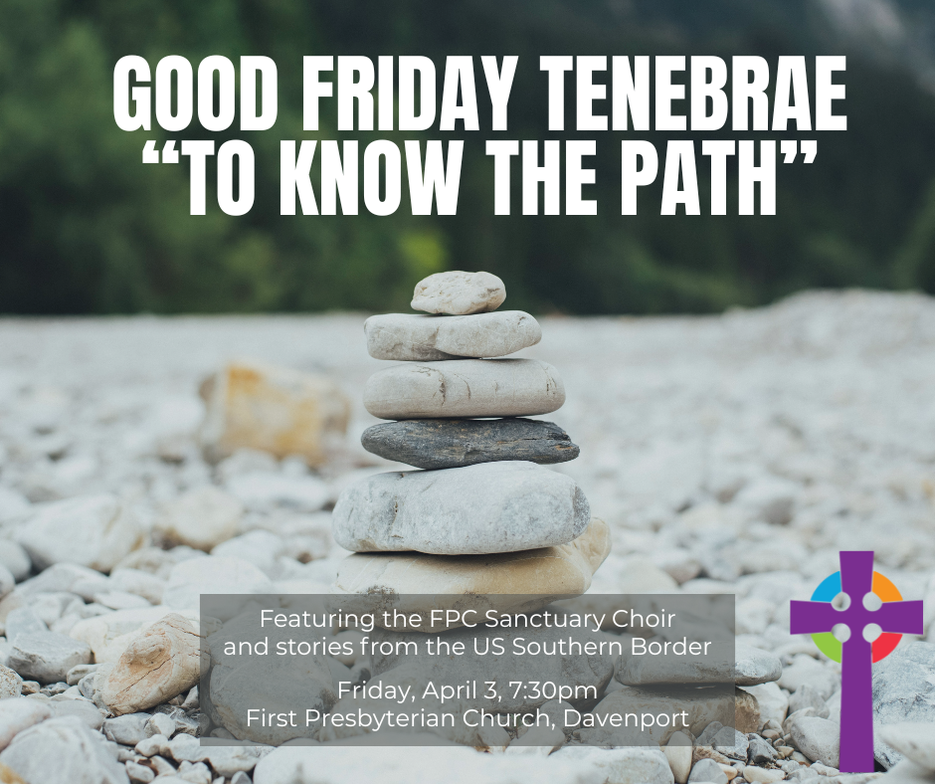
On Good Friday (April 3) at 7:30pm, the Sanctuary Choir will present a new landmark choral work titled To Know the Path. Scored for choir, soloists, flute, bassoon, cello, and percussion, this unique and moving work by American composer Linda Kachelmeier sets ancient Christian texts and poetry gathered or written by Athena Kildegaard that combine stories of migrant journeys with the Crucifixion narrative of Christ. To Know the Path is the result of a joint commission by the Minneapolis-based choir Border CrosSing, the Amherst College Choral Society, and Central Presbyterian Church in St. Paul, Minnesota (where the Sanctuary Choir sang and worshiped on our Twin Cities tour in July 2023). These three ensembles premiered the work in 2024.
To Know the Path is in eight movements, based on the canonical hours of the day, a feature of Catholic monastic life. The piece moves from pre-dawn morning to evening, forming a parallel with the Tenebrae Service of Darkness that has become a tradition at First Pres. Readings from the Crucifixion portions of the Gospels will introduce movements, combined with stories from individuals who traveled to El Paso, Texas and Juárez, Mexico as part of the Border Encounter trip last fall, as the lights will slowly be dimmed to darkness.
Rev. Kris Schondelmeyer says of this service: “Through the music of To Know the Path by Linda Kachelmeier and stories from those who traveled on the Border Encounter to El Paso and Ciudad Juárez, we will hear real human encounters—stories that carry both dignity and deep suffering—drawing us closer to lives often kept at a distance. Good Friday reminds us that Jesus suffered in a real body, within real systems, as one pushed to the margins. And the Gospel calls us to recognize that same sacred humanity in others—and to resist the temptation to look away from the suffering that exists in our world, especially when it is shaped by systems we benefit from and participate in. In this way, the cross confronts us with a moral crisis of our own time: Will we turn away, or will we see? This is a journey that invites us to see more clearly, to honor the humanity in every person, and to open ourselves to a compassion that transforms.”
While the text of the work quotes John Donne and several medieval Latin chants, the bulk of the music sets poetry by Minnesota-based poet and professor Athena Kildegaard. Kildegaard writes of her contribution to the work, “In the 14th Century a Franciscan known as the Pseudo-Bede wrote about the necessity to imagine as fully as possible the Lord’s suffering on the cross. He thought that in prayer you must ‘regard yourself as if you had our Lord suffering before your very eyes, and that he was present to receive your prayers.’ I have been watching the tragedy unfolding on our southern border—people coming north to escape violence and poverty and I have been watching how our current administration is unwilling to welcome them. Writing the words of To Know the Path has been an effort to imagine that tragedy. I have borrowed ideas from a New York Times editorial by an anonymous Salvadoran woman who was held with her son in a detention center. I have used phrases from John Donne’s moving ‘Devotions Upon Emergent Occasions.’ I borrowed the rhythms of St. Thomas Aquinas’ ‘Lauda Sion,’ and I made a very loose translation of part of the ‘Veni Sancte Spiritus.’ In this work, the hours of prayer are a journey from dark to light and back to dark, a journey away from home and toward home. Finding and making a home are quintessential acts of dignity. Like Medieval religious followers, we must imagine ourselves into the shoes of the migrants and refugees around the world. These words are my prayer for understanding and welcome and for the dignity we all deserve.”
Composer Linda Kachelmeier echoes the poets description of the multi-stylistic approach and human depth in this work: “Musically, I have been influenced by ancient chants from many different sources including Georgian Orthodox, Gregorian chant, Greek Orthodox, and Kabbalist Jewish prayers. I see these all as a call for communal prayer and devotion, a way to connect with each other. Silence is a key part of this work and is built into each movement to create some meditative space for the musicians and listeners. This cantata uses prayer as a metaphor for opening our eyes (awareness) to knowing the path, and our willingness to get on the path with each other (compassion).”
The experience of learning this piece as a musician and of teaching it to my singers has been profound. Every Good Friday, we retell the story of Christ’s death, which is always moving and about which there is a great body of music. Adding this element of the suffering of the members of the spiritual body of Christ, listening to and telling the stories of migrants who endured much hardship and suffering for the faint promise of a better life, further humanizes suffering and also grounds us in community and communion with the members of the body of Christ worldwide.
It is fitting that the Performing Arts Series hosted Sangat last weekend, a trio of incredibly talented musicians from both Sufi Islamic and Sikh traditions. This cross-cultural and interfaith exchange is key to their music making and their mission as an ensemble. The lead singer and trumpet player, Sonny Singh, reminded us that we are all One. We are all part of the same Sangat (“community”), and it is our duty to respond when members of that community are suffering. Offering To Know the Path seems like an appropriate (if wonderfully unintended) way to follow Sonny’s charge.
It is our hope that you will find peace and meditation in this service, but that you will also take with you a renewed call for compassion and justice for our migrant siblings. When part of the body of Christ suffers, the full body suffers. Join us.